Two moon calendars can put the same new moon on different days without either one being wrong. Start by checking the time zone. An astronomical event has a particular instant; the date printed beside it depends on the clock used to describe that instant.
Before changing your plans, compare the full date, time, and time zone. A screenshot that says only “new moon Monday” leaves out the information you need.
What kind of time are you looking at?
Before opening another calendar, decide what question you want it to answer. “When is the full moon?” can mean an event time, an evening to look outside, or a date to write in a journal. Those are different planning jobs.
| Your question | Look for | A detail to keep with it |
|---|---|---|
| When does the phase occur? | An exact primary-phase timestamp | The named time standard or time zone |
| When can I look for the Moon? | A local observing or rise/set forecast | Location and date |
| What does this daily icon mean? | The publisher’s display explanation | Whether it represents a particular hour |
| When will I do a reflection exercise? | A time that fits your plans | Your chosen time, recorded separately |
The last row is your decision. A personal appointment can be practical even when it does not coincide with an astronomical instant. Keeping the two entries separate makes it easier to enjoy a symbolic practice without arguing with the calendar.
Change the clock.
Keep the same instant.
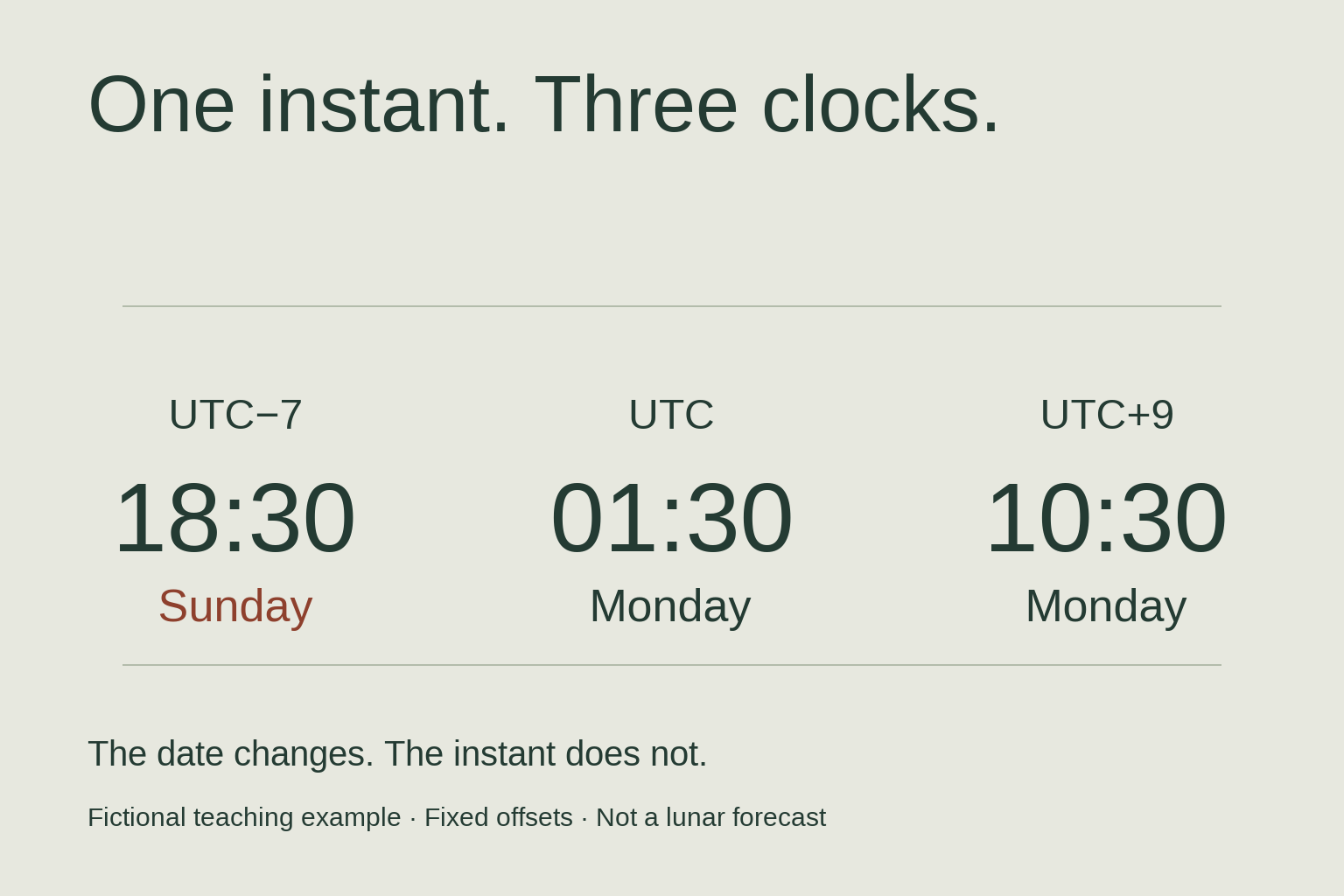
Our fictional phase happens on Monday at 01:30 UTC. Pick an offset and see why the calendar date can change.
Fixed offsets are teaching examples, not city timezones. Daylight-saving rules are not applied.
01:30 − 7 hours = 18:30 on the previous day
Illustrative example only · Not an actual lunar event or forecast
One instant, different calendar dates
Astronomers define the four primary phases—new moon, first quarter, full moon, and last quarter—at specific points in the Sun–Moon geometry. Those phase instants are shared worldwide. Your location changes their local clock labels, rather than creating a separate new moon. US Naval Observatory: phases of the Moon
UTC, Coordinated Universal Time, gives us a common reference. A UTC offset tells you how many hours to add or subtract to obtain a particular local time.
Illustrative example only: these are invented times, not an actual lunar event or forecast. Suppose a new moon happens on Monday at 01:30 UTC.
| Clock setting | Calculation | Local date and time |
|---|---|---|
| UTC−7 | Subtract seven hours | Sunday, 18:30 |
| UTC+1 | Add one hour | Monday, 02:30 |
| UTC+9 | Add nine hours | Monday, 10:30 |
The first conversion crosses midnight into the previous day. A calendar using UTC−7 would therefore mark Sunday, while the other two would mark Monday. All three would describe the same event.
These offsets are deliberately not attached to cities. For a real date, use the offset that applies to your location then. Daylight-saving rules and government decisions can change local offsets; the IANA Time Zone Database tracks those changes.
Try the conversion in both directions
Start with the invented Monday 01:30 UTC example above. Subtracting seven hours gives Sunday 18:30. Now reverse the calculation: add seven hours to Sunday 18:30, and you return to Monday 01:30.
That return trip is a useful arithmetic check. If two calendar entries look different, put both on the same reference clock before comparing them. Include the day as well as the hour; moving through midnight is the point people can miss when they copy only a time.
A half-hour offset works the same way. In this fictional example, UTC+5:30 gives Monday 07:00. The rule is addition or subtraction of the stated offset, not rounding the location to a whole hour.
An offset is not a city. For a real event, first establish the applicable local offset for that date. The examples here teach the calculation; they are not current moon times and should not be copied into an event invitation.
A phase instant is different from its appearance
The Moon’s appearance changes continuously. The exact full moon is a calculated instant, while the Moon can look full on neighboring nights. A rounded-looking Moon on Sunday does not, by itself, contradict a calendar listing full moon on Monday. US Naval Observatory: phase definitions and appearance
Likewise, the astronomical new moon is not the first thin crescent you notice afterward. At new moon, the Moon’s night side faces Earth and its illuminated side faces the Sun. A waxing crescent is a later phase. NASA: moon phases
This distinction matters when comparing a precise event table with a calendar that uses one small Moon illustration for each day. Check whether that illustration represents a stated time, an approximate daily appearance, or an exact phase marker. If the publisher does not explain it, the icon alone cannot settle the disagreement.
Moonrise is a separate appointment
Moonrise describes the Moon reaching a location’s horizon, not the occurrence of a lunar phase. The US Naval Observatory’s definitions also explain that a location can have a date with no moonrise or no moonset.
So an empty rise-time cell is not automatically a broken calendar. Read the legend before substituting a time from another city. If your purpose is an evening walk or a photograph, use the location-specific information relevant to that plan. If your purpose is comparing full-moon timestamps, keep the rise-time column out of the comparison.
Similarly, the word “transit” on an observing table needs its own definition. Resist treating every time next to a Moon symbol as another answer to the same question. The label above the number matters as much as the number itself.
Check these details before choosing a date
- Match the event. Confirm that both entries refer to the same phase, month, and year.
- Find the time zone. Look in the calendar settings, caption, or footnote. Do not assume every website has detected your location.
- Check the complete timestamp. Compare the time as well as the date, including whether the clock uses 12 or 24 hours.
- Use a shared reference. Convert both entries to the same time zone before deciding they disagree.
- Read the display notes. Look for an explanation of daily icons, event times, and rounding.
For a published reference, the US Naval Observatory’s phase table supplies primary-phase dates and times and explicitly labels its output as Universal Time. Read that label and its conversion guidance instead of treating the table as a local calendar.
If two entries still differ, keep the original timestamps and ask each publisher which calculation and display convention it uses. Do not “correct” one by moving the date until the labels agree.
Three disagreements, three next steps
One calendar says Sunday; another says Monday. Compare their complete timestamps and offsets. Use the invented example to understand how a midnight crossing works, then apply the calculation to the actual entries you have recorded. Do not assume the same explanation fits before checking.
The dates match, but the icons look different. Find the display notes. You may be comparing a precise event marker with a daily illustration. Without an explanation of what the icon represents, its shape is insufficient evidence of an error.
The converted timestamps still differ. Save the entries and check that the year, event and source edition match. If they do, ask the publishers about their calculation and display conventions. Report the size of the discrepancy rather than rounding it away. This guide does not diagnose a particular provider’s calculation.
When buying a printed calendar, look for the same clarity before checkout: a stated zone or conversion convention, a readable key and a current edition. Attractive artwork and usable time information can coexist. If the product page does not explain the latter, that is a question for the seller—not a detail you should have to invent.
A small worksheet for your next comparison
Copy this into a note:
- Phase and year:
- Calendar A: date, time, time zone:
- Calendar B: date, time, time zone:
- Both converted to the same zone:
- Explanation found in the calendar notes:
- Date and time I will use for my own plans:
For a personal reflection ritual, you can choose a convenient time nearby and record it separately from the astronomical event. That makes your schedule clear without turning an optional symbolic practice into an appointment you must get exactly right.
For an optional reflection exercise to accompany your plans, try our five-minute new moon ritual.
Astronomy references and time-zone documentation checked October 6, 2026. Every conversion example is explicitly fictional. Any accompanying offset explorer demonstrates arithmetic; it is not a live ephemeris, moonrise forecast or automatic city/DST service.